
🎵 Now Playing: “My Heart Will Go On” – Celine Dion
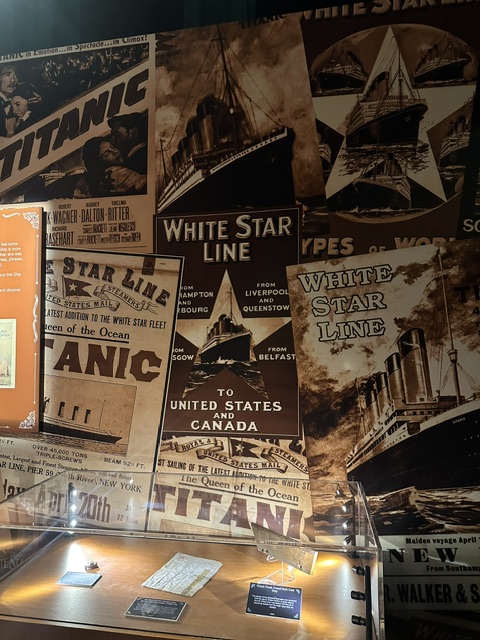
As a lifelong fan of James Cameron’s Titanic, finding out that Titanic Exhibit Baltimore: An Immersive Voyage had opened at the Inner Harbor immediately shot to the top of my summer bucket list. The movie has been one of my favorites for as long as I can remember, so the chance to see real artifacts recovered from the wreck, without leaving my hometown, was something I couldn’t pass up.
Before I even stepped into the exhibit, I found myself taking a trip down memory lane. The museum is housed inside the historic Pratt Street Power Plant, an industrial building that once generated electricity for Baltimore and powered the city’s streetcars. Growing up, I remember coming here when it was home to Barnes & Noble. Walking back into the building felt incredibly nostalgic. While the structure remains the same, with its exposed steel and three floors connected by elevators, the space has been completely transformed into an immersive museum experience.
Also, the location couldn’t be more fitting. The Pratt Street Power Plant sits along Baltimore’s Inner Harbor, directly across from several of the city’s maritime museums and historic ships, making the waterfront itself feel like an extension of the exhibit. Baltimore has always been a port city with a rich maritime history, so experiencing a museum dedicated to one of the world’s most famous ocean liners while overlooking the harbor created an atmosphere that made the story feel even more immersive. Before I even walked inside, the setting had already begun transporting me back in time.
That industrial architecture ended up being the perfect setting. As I began the self-guided tour, I was led through long metal corridors that reminded me of the engineering and construction of the Titanic itself. The exposed beams and steel almost made it feel as though you were boarding a ship rather than walking into an exhibit.
What impressed me most was how interactive everything was. The exhibit doesn’t simply display artifacts behind glass, but it tells the whole story from the over 2 thousand people who boarded and to those 700 who survived. Throughout the museum, projections, sound effects, recreated rooms, and interactive scenes bring the Titanic to life. Visitors can stand on the captain’s bridge, witness the moment the ship struck the iceberg, and experience the chaos as water flooded the lower decks. The designers did an incredible job blending historical artifacts with cinematic storytelling. As someone who knows the movie, scene for scene, I definitely noticed how faithfully many parts of the exhibit echoed those iconic moments while still honoring the real people behind the tragedy.
Seeing authentic artifacts recovered from the ship was surreal. Clothing worn by passengers, elegant china from the dining rooms, personal belongings, books, and other recovered items served as reminders that these weren’t simply movie props but they were items that belonged to real people whose lives ended over a century ago.
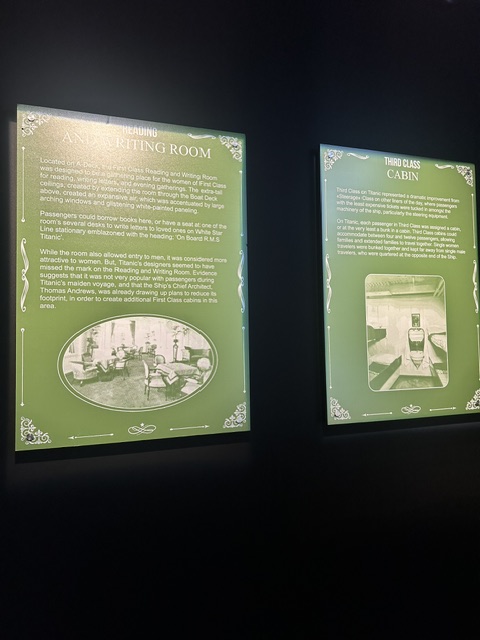
One detail that stood out to me was the dramatic difference between the passenger classes. Although everyone boarded the same ship with the same destination in mind, their experiences were worlds apart. Walking through recreations of the first, second, and third-class accommodations, I couldn’t help but think about the phrase “separate but unequal.” The contrast was impossible to ignore. Everything from the bedding and dining ware to the floor tiles and furnishings reflected a clear social hierarchy. First-class passengers enjoyed extravagant amenities, including an onboard swimming pool and luxurious lounges, while third-class passengers received only the necessities.
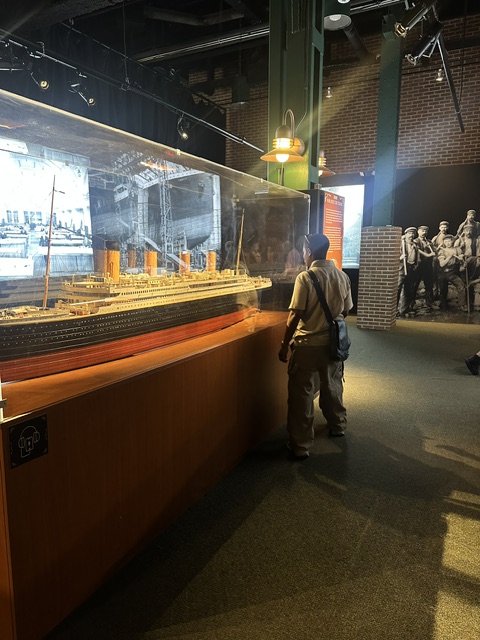
I also left with a completely different understanding of the ship’s size. To have a 33-by-14-foot swimming pool onboard meant the Titanic was truly enormous. Watching the movie, I always knew the ship was massive, but standing among the scale models and learning about its layout made me realize just how large it really was. It was essentially a floating luxury hotel.
One thing I’ve learned while writing is that you don’t always have to travel far to discover something extraordinary; sometimes history comes to you. Sometimes it’s hiding inside a building you thought you already knew. The Pratt Street Power Plant became the place where I experienced one of history’s most unforgettable stories in an entirely new way.
Baltimore is often celebrated for places like Fort McHenry or the National Aquarium, but it’s also home to more than 60 museums, each offering its own unique perspective on history, art, science, and culture. Titanic Exhibit Baltimore: An Immersive Voyage is a reminder that some of the world’s greatest stories can be experienced right here in B-More.
Whether you’re a fellow historian like myself, a movie lover, or simply looking for something different to do in Baltimore, this exhibit is well worth adding to your itinerary. It’s proof that this city still has plenty of stories left to tell and I’m excited to share them with you.
Until next time,
Signed, A Baltimore Native


